Case story
Slashing Emissions Without Slowing Production
Case story
Slashing Emissions Without Slowing Production
ESP upgrades for a leading paper plant in China
Pulp and paper plants have to control dust emissions from three sources: the recovery boiler, the power boiler and the lime kiln.
Ash removal on a recovery boiler is particularly difficult because the particulates are small and sticky.
And if the recovery boiler has to be shut down for any reason, the entire production line has to be stopped.
Environmental standards in China are becoming increasingly stringent and for some manufacturers it is
a question of becoming compliant or being shut down.
For our customer, a world-leading producer of pulp and paper, choosing a supplier to upgrade their air pollution control system wasn’t just about meeting emissions regulations – they wanted reliable equipment from a trustworthy partner.
China is fighting hard to bring down emissions from its heavy industries. For the pulp and paper industry, dust emission limits have been cut from 20-35 mg/Nm3 to just 10 mg/Nm3, necessitating considerable upgrades across the industry.
For our customer this meant upgrading the air pollution control equipment for three lime kilns and two recovery boilers.
Dust emissions fall way below targets
Since completing the project, all installations have continuously recorded dust emissions well below 5 mg/Nm3 – a figure previously unheard of in the industry.
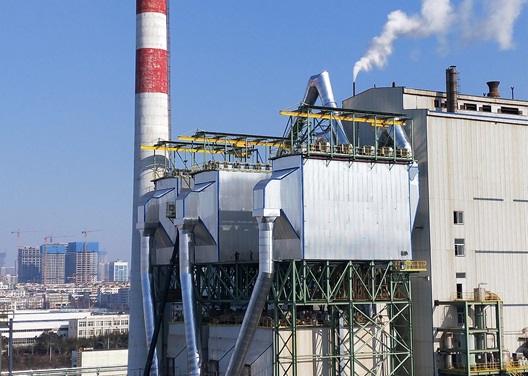
And it’s not only the emission figures that have impressed the company; innovative engineering also ensured maximum productivity during the project. For example, on one recovery boiler, we were able to erect three new ESP chambers while the boiler was still in operation. We built the new ESP chambers on a steel structure elevated above the existing ESP chambers, thus minimising downtime and ensuring continued productivity.
Meanwhile, on the other recovery boiler we simply added two new chambers on either side of the existing 4-chamber installation to achieve the new low emissions. Again, the boiler could continue operating while the work was
carried out.
For the two lime kilns, the existing ESPs are located on the roof of a building where there was just enough space to extend both units, adding one electrical field at the inlet and at the outlet. It was tight – but we made it happen.
Upgrading ESPs to meet lower dust emissions limits
As a first step on the road to low emissions, a new ESP was supplied for a lime kiln in 2018, with guaranteed particle emissions of less than 10 mg/Nm3.
This was followed by further contracts in 2019:
- Three new ESP chambers for one recovery boiler
- Two new ESP chambers in addition to an existing installation on a second recovery boiler
- Retrofit of the existing four ESP chambers on a recovery boiler, including the supply of new PIACS® DC4 ESP control panels, 3-phased T/R sets, new gas distribution screens and additional anti-sneakage screens, thereby ensuring that no gas can leave the precipitators untreated
- Retrofit of ESP chambers on two lime kilns, where two additional fields were added to each chamber
The contracts included design, part supply, ESP chambers, layout design, supervision of erection and commissioning as well as training.
Close collaboration with customer
To ensure a successful outcome and minimal installation time, preparation was key. We worked closely with the customer team throughout the project and sent our layout specialists to perform 3D scans of the facility to ensure that our solution would fit within the limited footprint.
The site activities began in June 2019 and were completed in early January 2020. This project involved a total of fourteen supervisors from four different countries. We arranged it so that every site – recovery boiler #1, recovery boiler #2 and the lime kilns – had a specific manager who completed a daily report for the customer. In this way we were able to keep everyone informed about the progress on the individual building sites – to the customer’s full satisfaction.
Case story
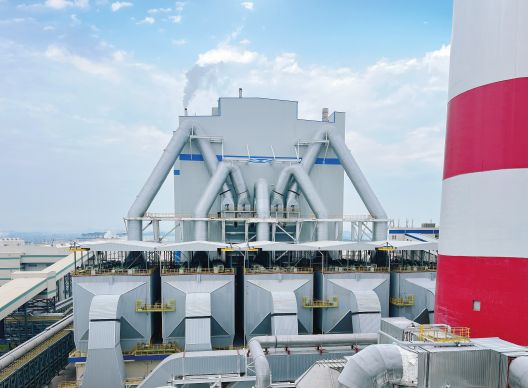
Liansheng Pulp & Paper: Ultra-Low Emissions at Record Scale
ESP performance for China’s largest recovery boiler In 2021 when Liansheng Pulp and Paper decided to set up China’s largest kraft pulp mill, the company chose a path defined by high standards, proven technology and long-term confidence. On a project of this scale, emissions control is about more than meeting requirements. It is about choosing […]
Learn more